2026 Icons
- Giorgio Armani
- Gabriel Attal
- Alvin Baltrop
- Frieda Belinfante
- Michael Bennett
- Rachel Crandall-Crocker
- Barry Diller
- Ernestine Eckstein
- Laïla El-Métoui
- Edward Enninful
- Andrea Gibson
- Marsden Hartley
- Muhsin Hendricks
- Patricia Highsmith
- Robert Joffrey
- Julie Johnson
- Lani Ka’ahumanu
- King James I
- Calvin Klein
- Abraham Lincoln
- Chris Pappas
- Pauline Park
- Paul Rudolph
- Amber Ruffin
- St. Vincent
- Jessica Stern
- Charles Sumner
- Jewel Thais-Williams
- Karl Heinrich Ulrichs
- Alok Vaid-Menon
- Edmund White
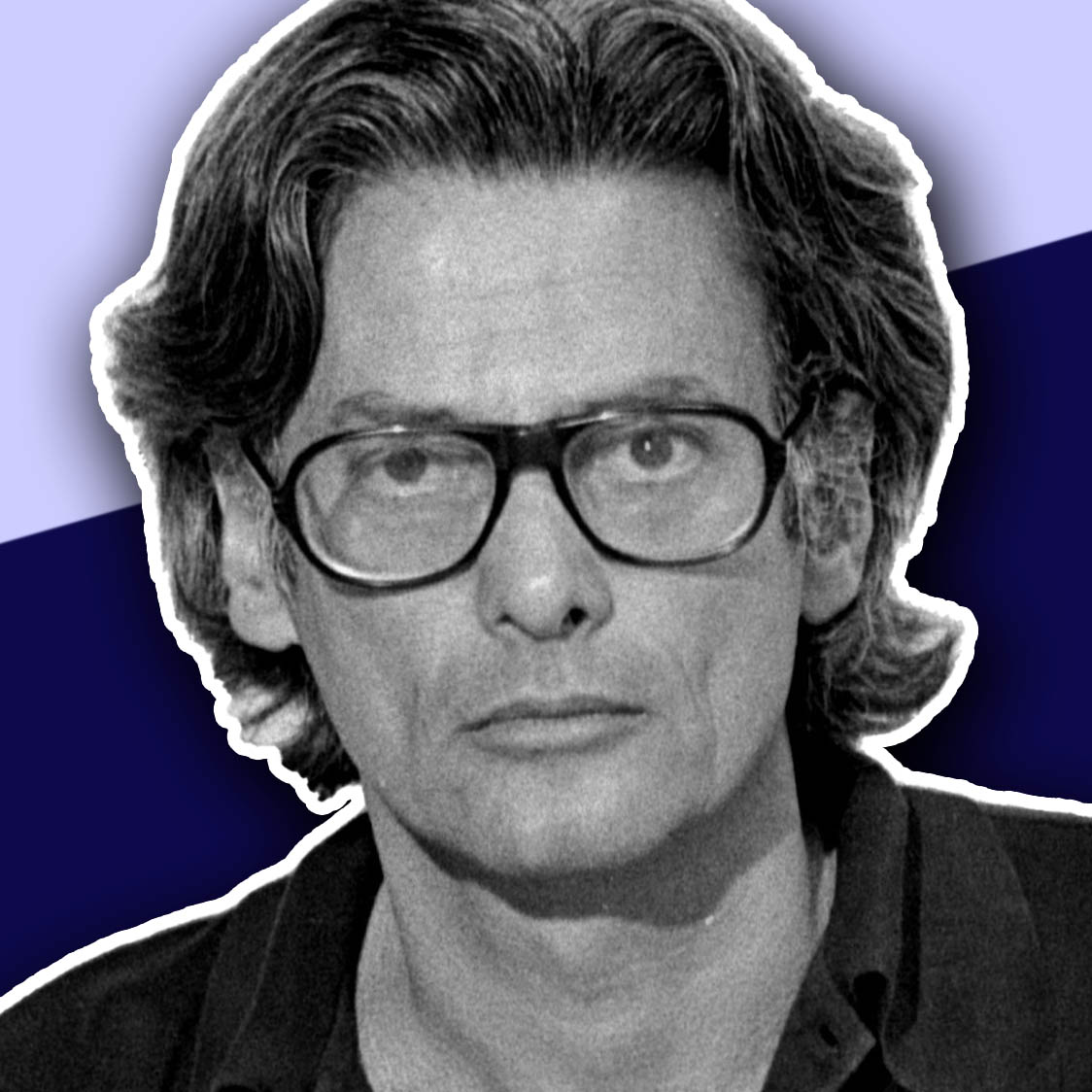
Richard Avedon
2022 Icon
Preeminent Photographer
b. May 15, 1923
d. October 1, 2004
“All photographs are accurate. None of them is the truth.”
Richard Avedon was a world-famous photographer who specialized in fashion and portraiture. Best known for his images of models and celebrities, his minimalist portraits of unknown people, including a bee-covered beekeeper, are among his most compelling works.
Avedon was born in New York City to Jewish parents who were employed in the apparel industry. At age 12, he joined a camera club, sparking his lifelong passion. With his later-famous friend, James Baldwin, he co-edited his public high school’s prominent literary magazine. Avedon was named Poet Laureate of New York City High Schools.
Avedon joined the Merchant Marines in 1942, where he took identification photos. He left after two years to pursue photography professionally. He became a protégé of Alexey Brodovitch, an influential photographer and the top graphic designer for the fashion magazine Harper’s Bazaar.
Avedon started freelancing at 22. He began a 20-year working relationship with Harper’s Bazaar, taking what were then unconventional, out-of-studio action photos of models. The magazine soon made him its lead photographer. During this period, Avedon also worked for other popular magazines, such as Life and Look, and shot personality-revealing portraits of famous people, including John F. Kennedy and Elizabeth Taylor.
In 1965, when racism was rampant, Avedon quit Harper’s over controversy concerning his collaboration with models of color. He joined Vogue, where he worked until 1994, when The New Yorker hired him as its first staff photographer.
Avedon also maintained his own studio, where his work for leading brands such as Revlon and Versace contributed to some of the world’s most successful advertising. He explored pet projects, including portraits reflecting the Civil Rights Movement, such as those of Martin Luther King and Malcolm X, and the Vietnam War.
During his life, Avedon published 11 photo books, and the Smithsonian and other major museums presented his solo exhibitions. In 1978 he became the first living photographer with a show at the Metropolitan Museum of Art. In 1985 the Amon Carter Museum commissioned him to capture the spirit of the American West though photos of ordinary people. His gritty, startling portraits contradicted the romanticized image of the West, igniting intense controversy as well as widespread critical acclaim.
Avedon was out as a bisexual to his close circle and married twice to women. His second marriage lasted, though Avedon reportedly had a decade-long affair with the director Mike Nichols.
Avedon died shortly after suffering a cerebral hemorrhage on assignment for The New Yorker. The New York Times published his obituary.