2026 Icons
- Giorgio Armani
- Gabriel Attal
- Alvin Baltrop
- Frieda Belinfante
- Michael Bennett
- Rachel Crandall-Crocker
- Barry Diller
- Ernestine Eckstein
- Laïla El-Métoui
- Edward Enninful
- Andrea Gibson
- Marsden Hartley
- Muhsin Hendricks
- Patricia Highsmith
- Robert Joffrey
- Julie Johnson
- Lani Ka’ahumanu
- King James I
- Calvin Klein
- Abraham Lincoln
- Chris Pappas
- Pauline Park
- Paul Rudolph
- Amber Ruffin
- St. Vincent
- Jessica Stern
- Charles Sumner
- Jewel Thais-Williams
- Karl Heinrich Ulrichs
- Alok Vaid-Menon
- Edmund White
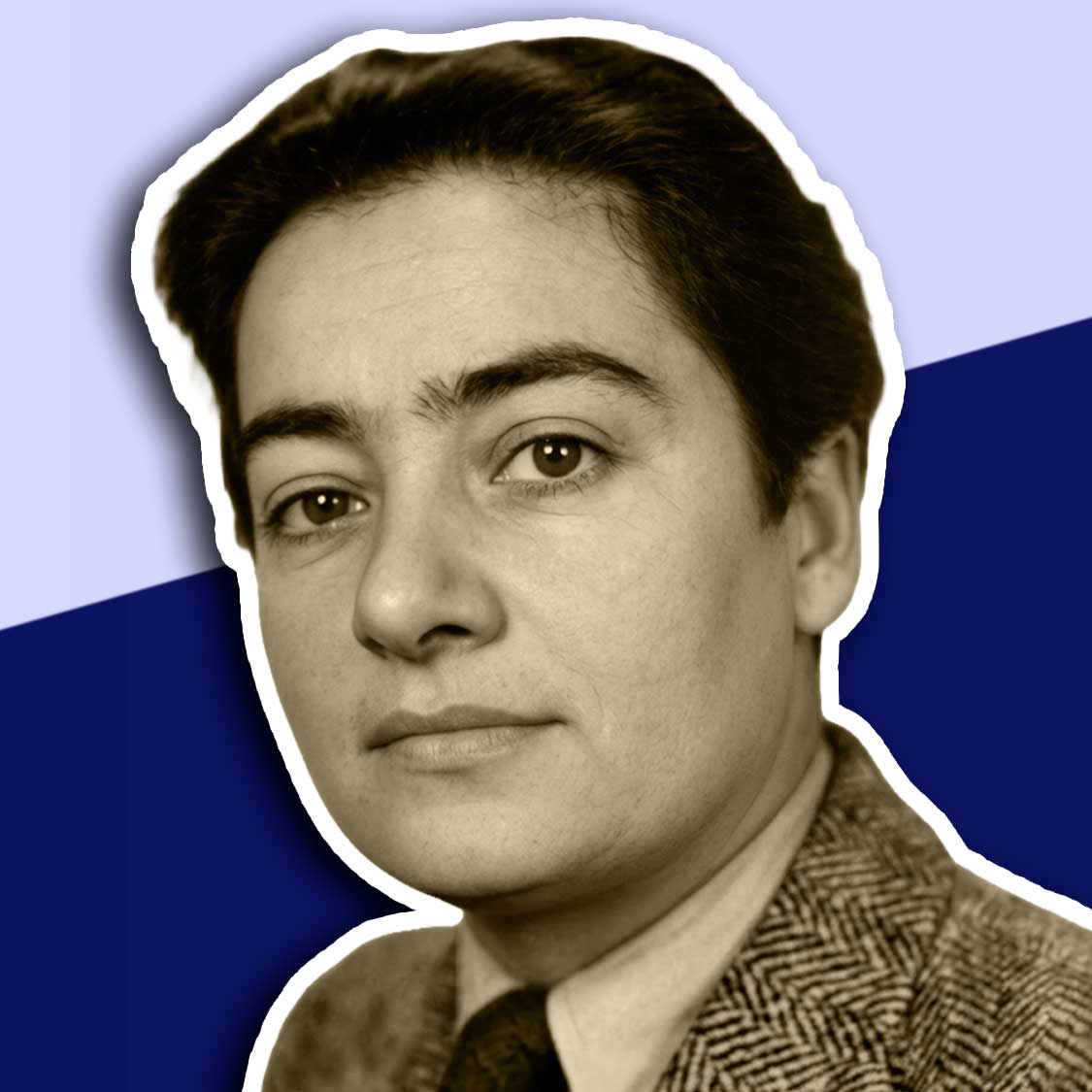
Frieda Belinfante
2026 Icon
Frieda Belinfante
Cellist & Conductor
b. May 10, 1904
d. March 5, 1995
“I’ve always helped people, whether they’re worth it or not comes out later.”
Frieda Belinfante was a Dutch lesbian cellist and one of the world’s first female conductors. She was active in the Dutch resistance during World War II and later became the founding artistic director and conductor of the Orange County Philharmonic Society in California.
Belinfante was born in Amsterdam to a Jewish father and a Christian mother. Her father was a well-known pianist and music school director. Her parents divorced when she was 11, and her father died eight years later.
Belinfante began playing the cello at age 10. She graduated from the Amsterdam Conservatory and made her professional debut at 17, performing with her father. That year, she moved in with her girlfriend, the composer Henriëtte Bosmans.
Near the end of her relationship with Bosmans, Belinfante met Johan Feltkamp. At his insistence, they married in 1930. They divorced in 1936.
In 1938, the Amsterdam Concertgebouw invited Belinfante to form a chamber ensemble, Het Klein Orkest (the Little Orchestra). She remained the ensemble’s artistic director and conductor until 1941, making her the first woman to conduct an ongoing professional orchestra in Europe.
When the Nazis invaded the Netherlands, Belinfante put her career aside to join the resistance, helping musicians oppressed by German cultural restrictions and aiding persecuted Jews, children of mixed Jewish-gentile marriages, and homosexuals. She forged documents and prepared fake IDs. To keep vital information from the Nazis, she was involved in the daring destruction of Amsterdam’s population registry. When the Gestapo retaliated, she went into hiding, disguising herself as a man, forging an ID, and calling herself “Hans.” In 1943, she sold her cello and escaped on foot to Switzerland. After a brief incarceration for illegal immigration, she secured U.S. sponsorship.
In 1947, Belinfante immigrated to the United States, settling in California. She joined the UCLA music faculty in 1949 and, in 1953, formed The Vine Street Players to continue conducting. In 1954, she became the founding conductor and artistic director of the Orange County Philharmonic Society. When her contract ended in 1962 for various reasons, including her gender and sexual orientation, she established a small private studio to train other musicians.
In 1994, the United States Holocaust Memorial Museum recognized Belinfante’s courageous work for the Dutch resistance. She died of cancer a year later, but not before the Dutch government featured her story in an exhibition about the persecution of LGBTQ+ people during World War II.